
The Heart of the Dark: How Image Intensifier Tubes Master the Night
The Heart of the Dark: How Image Intensifier Tubes Master the Night
When you look through a PVS 14 and see a crisp, illuminated world in the dead of night, you aren't just looking through a camera—you are witnessing a marvel of vacuum electronics. At the core of every high-end night vision device lies the Image Intensifier Tube (IIT). Often called the "heart" of the system, this component is what separates professional-grade gear from toy-like digital alternatives.
But how exactly does a small glass-and-metal cylinder turn a few stray photons into a tactical advantage? Let’s dive into the hardcore science of the IIT.
Three-Stage Transformation: From Photons to Vision
An Image Intensifier Tube doesn't just "brighten" light; it converts and amplifies it through a sophisticated three-stage process:
1. Translator: Photocathode
Everything starts at the front of the tube. When the few available photons (from starlight or moon-glow) hit the Photocathode, they are converted into electrons.
The Technical Edge: In Gen 3 image intensifier tubes, we use Gallium Arsenide (GaAs) for the photocathode. This material is exceptionally sensitive to the near-infrared spectrum, allowing the tube to "see" in conditions where Gen 2+ systems might struggle.
2. Multiplier: Microchannel Plate
This is where the magic happens. The Microchannel Plate (MCP) is a wafer-thin disc containing millions of microscopic glass tubes. As electrons pass through these channels, they strike the walls and trigger a "secondary emission," cascading into thousands of additional electrons.
Why it Matters: A high-quality MCP allows for massive amplification without distorting the image, ensuring that even the dimmest environments are rendered with clarity.
3. Painter: Phosphor Screen
Finally, the massive cloud of electrons hits the Phosphor Screen. The kinetic energy of the electrons causes the phosphor to glow, converting the signal back into visible light.
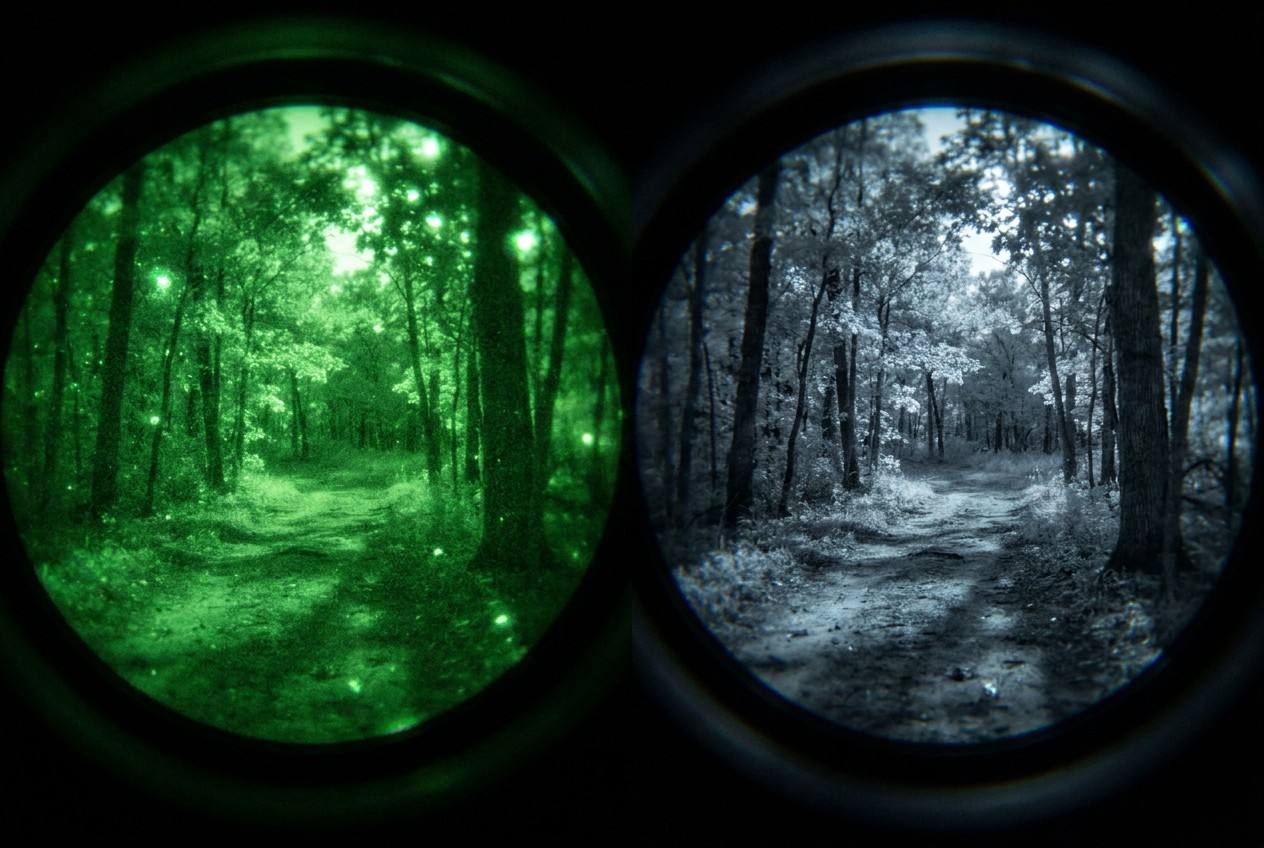
Green Phosphor(P43) vs. White Phosphor(P45): While the classic green glow is legendary for its efficiency, our White Phosphor tubes are increasingly preferred for their high contrast and reduced eye strain during long-duration missions.
Decoding the Specs: What is FOM?
In the industry, we use FOM (Figure of Merit) as the ultimate benchmark for a tube's "IQ." It is calculated by multiplying Resolution by Signal-to-Noise Ratio (SNR).
- SNR (Clarity): Think of this as the "graininess" of the image. A high SNR means a clean, "snow-free" view even in total darkness.
- Resolution (Detail): This determines your ability to distinguish between two close objects—critical for identifying targets or navigating rocky terrain.