How To Protect A Night Vision Binocular?
Engineer Manager:
MS. Melin,
WhatsApp:+86-18291418396,
Email: melin@ireeda.com
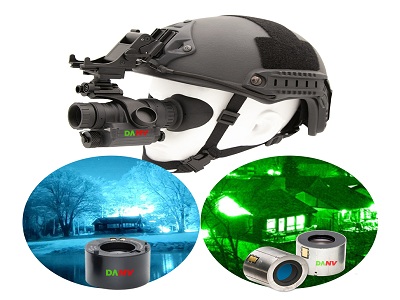
Low-light night vision devices have long been used in the military and other departments, and are indispensable as nighttime observation equipment. As a commonly used nighttime observation artifact, low-light night vision equipment also comes with after-sales maintenance. After inspection, it was found that part of the reason was caused by improper user operation. Any high-tech product should start with mastering theoretical knowledge. As long as the knowledge is mastered, user cannot only ensure product safety, but also bring out the product's full capabilities. Today we will introduce the principles of low-light night vision devices in detail, hoping to help everyone.
Basic knowledge of low-light night vision devices
Low-light night vision device is a device that utilizes low-light night vision technology. Low-light night vision technology, also known as image intensification technology, is a photoelectric imaging technology that uses night vision goggles with image intensification tubes to enhance target images illuminated by weak light for observation. Low-light night vision equipment is currently the most produced and widely used night vision equipment in foreign countries. Before using low-light night vision devices correctly, you must master basic low-light knowledge and understand the precautions.
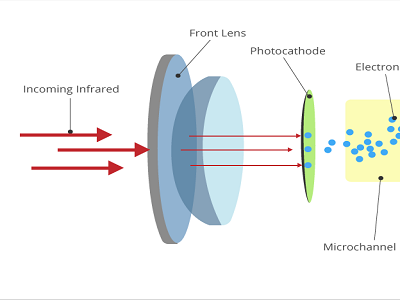
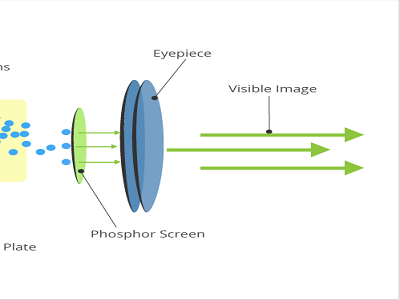
Detailed explanation of the basic principles of working of low-light night vision devices
Illuminance is a physical quantity that refers to the luminous flux of visible light received per unit area. It is used to indicate the intensity of light and the degree to which the surface area of an object is illuminated. The unit is Lux (Lux or Lx). In nature, under direct sunlight in summer, the illuminance can reach 60,000 to 100,000 lux, or 6x10⁴ to 1x10⁵Lx; under cloudy outdoor conditions, the illuminance can reach 10,000 to 30,000 lux, or 1x10⁴ to 3x10⁴Lx; on a clear day the indoor illuminance in summer is about 100 to 550 lux; the indoor illuminance at night is about 50 to 300 lux; the illuminance under outdoor moonlight conditions is about 0.01 to 0.2 lux, that is, 1x10⁻² to 2x10⁻¹Lx; there is no moonlight or starlight conditions at night on a clear day,the illuminance is about 0.001 lux, which is 1x10⁻³Lx. The above illuminance are unchangeable realistic conditions of nature.
The illuminance for human eyes to clearly observe scenery and read is 50 lux to 100,000 lux, that is, 50 to 1×10⁵Lx. Under starlight and moonlight lighting conditions at night, the human eye cannot observe, discover, and identify targets normally. In daily normal life, there are many light damage and risk factors to the human eye. For example, looking directly at the sun on a sunny day for more than 10 minutes or looking directly at the arc light of a welding for more than 5 minutes will cause irreparable damage to the retina of the human eye. Therefore, when the human eye encounters a strong light source, it is natural for people to avoid or close the eyes to protect the retina from being burned.
The low-light night vision device uses a low-light objective lens to image distant objects and scenery illuminated by starlight or moonlight on the input surface of the low-light image intensifier, and then enhances the image signal by 10,000 to 100,000 times. The output surface of the device forms a fluorescent screen image for human eyes to observe. The light intensity of the low-light night vision device must be strictly controlled between 0.001 lux and 1 lux, that is, 10-3 ~ 1Lx. At the same time, you should also avoid staring for a long time (more than 2 minutes) when using low-light night vision devices at night to observe distant street lights, illuminated billboards, the moon, and nearby car taillights and LED signal lights, because the microscopic components in low-light night vision devices The input surface of the optical image intensifier (photocathode surface) is equivalent to the retina of the human eye. It is extremely sensitive and can easily cause irreversible damage.
Today’s introduction ends here. The next post will introduce you to specific protection methods, so stay tuned.
Engineer Manager:
MS. Melin,
WhatsApp:+86-18291418396,
Email: melin@ireeda.com